Introduction: Modernizing Email Infrastructure in the Financial Sector
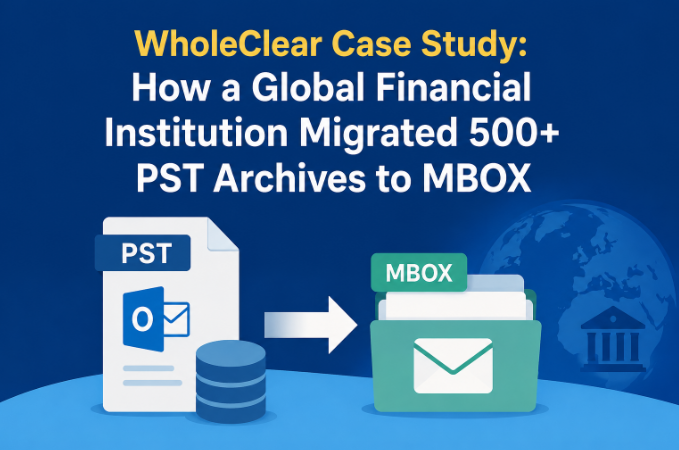
Email data is one of the most critical digital resources for financial institutions. A multinational financial services company needed to modernize its email infrastructure and migrate historical Outlook archives to a platform that supports MBOX files. Compliance records, customer communications and internal correspondence had to be migrated from over 500 PST archives accumulated over 15 years. The organization's email archiving infrastructure was in a challenging state: many archives were unavailable, many PST files were larger than 2 GB and migration period was limited to 90 days. Any loss of data could have led to compliance risks and operational disruptions. This case study looks at how the institution successfully completed the migration project while maintaining business continuity and preserving email integrity.
Key Project Statistics and Metrics
Industry: Financial Services
Size of Organization: 12,000+ staff
PST Archives Total: 500+
Data Size: 8.5 TB
Migration Duration: 90 Days
Departments Involved: Finance, Operations, IT, Compliance
Destination: MBOX Format
Data Retention Requirement: 100%
Email Recovery Success Rate: 99.8%
The Enterprise Challenge: Managing 15 Years of Legacy PST Archives
The institution had used Microsoft Outlook for more than a decade. Different infrastructure upgrades, employee transitions resulted in creation and storage of PST files across different systems. Key challenges were:
• Large number of archived PST files
• Multiple legacy versions of Outlook
• Oversized mailbox files
• Complex folder structures
• Compliance requirements are rigorous
• Limited migration window
• Need to preserve attachments and metadata
At first, the IT team used native export methods and manual conversion processes. But the process quickly spun out of control.
The Pitfalls of Manual PST-to-MBOX Migration Methods
The team first considered manual conversion options and then developed a specialized solution.
Actions Taken
-
Find PST files in storage repositories.
-
Open each file in Outlook.
-
Export mailbox contents.
-
Import data into an intermediate email client.
-
Manually create MBOX files.
-
Check folder structures.
-
Compare migrated email to original archive.
Issues Faced
• Too much time spent in processing.
• Heavy reliance on Outlook installs.
• Results differ from system to system.
• Problems with large mailbox files.
• Increased likelihood of human error.
• High cost of verification.
After testing the 25 archives, the team estimated that the manual approach would require more than six months to complete the project—well beyond the approved timeline.
Professional PST to MBOX Converter
The organization used WholeClear PST to MBOX Converter as its primary tool to expedite the migration process. The reason behind choosing the software was its ability to do direct conversion from PST to MBOX, support for large mailbox files, preserving email properties, preview functionality and preserving folder hierarchy during migration process. The tool supports Outlook PST files from multiple versions with attachments, email formatting and metadata intact.
Step-by-Step Implementation of the Migration Process
The IT team developed a formal migration process.
Step 1: Archive Evaluation
The PST files were all classified by size, age, department, and business priority.
Step 2: Loading PST File
The selected PST files were added to the software for scanning and evaluation.
Step 3: Check Your Data
Administrators could review folders and mailbox content before migration, identify priority archives and validate data with the preview feature.
Step 4: Export MBOX
The migration team selected MBOX as the target format and configured the destination for the output.
Step 5: Running the Conversion
Department-wise batch conversion jobs were scheduled to minimize operational impact.
Step 6: Verification
Supported email clients were used to import converted MBOX files to test. We examined folder structures, attachments, email headers and timestamps for consistency. The software maintained the metadata and mailbox hierarchy all through.
Key Benefits
The organization reported a number of benefits after adapting the migration strategy.
Faster Processing: Large PST archives were converted much faster than if we were to do this manually.
Preservation of Metadata: The email properties such as sender information, recipients, dates, attachments and formatting remained unchanged after migration.
Maintain Folder Hierarchy: The existing folder and subfolder structure was maintained to facilitate easier post-migration navigation.
Streamlined Workflow: The migration process was less resource intensive administratively and less complex to operate.
Cross-Platform Compatibility: Various MBOX compatible email clients like Thunderbird, Apple Mail, Entourage, Eudora, and others could access the generated MBOX files.
Best Practices for Enterprise PST to MBOX Conversion
Recommendations for organizations to maximize migration success are:
• Backup before start migration.
• Arrange PSTs based on importance and size.
• Test a small sample before full deployment.
• Review converted data after each migration phase.
• Keep audit logs for compliance purposes.
• For large projects, use batch scheduling.
• Examine the mailbox permissions and retention requirements.
• Verify attachment availability post-migration.
Frequently Asked Questions (FAQs)
Is it safe to move large PST files?
Yes. The tool supports large PST files and provides secure conversion without any loss in the quality of emails.
Will attachments to emails be kept whole?
Sure. Attachments are retained during conversion along with email content & metadata.
Do I need to have Outlook when migrating?
The software supports PST to MBOX conversion without the need for Outlook in the migration workflow.
Does it keep the folder structure?
Yes. The original folder and subfolder structure is preserved after migration.
What email clients can open MBOX files created by this tool?
Converted files can be opened with Thunderbird, Apple Mail, Entourage, Eudora, Netscape, Spicebird and other MBOX compatible applications.
Conclusion: Ensuring Data Integrity and Compliance at Scale
Large scale email migrations usually have tight deadlines, compliance requirements and large volumes of data. Manual migration methods were inefficient and risky for the global financial institution. The organization benefited from the PST to MBOX Converter by streamlining the conversion process, safeguarding important email records, and accomplishing the migration as per schedule. The project proved that enterprises can migrate thousands of Outlook emails to MBOX format with data integrity, operational continuity, and regulatory compliance if they have the right planning, validation, and migration technology.